Free · Hands-on · Core labs need no API key
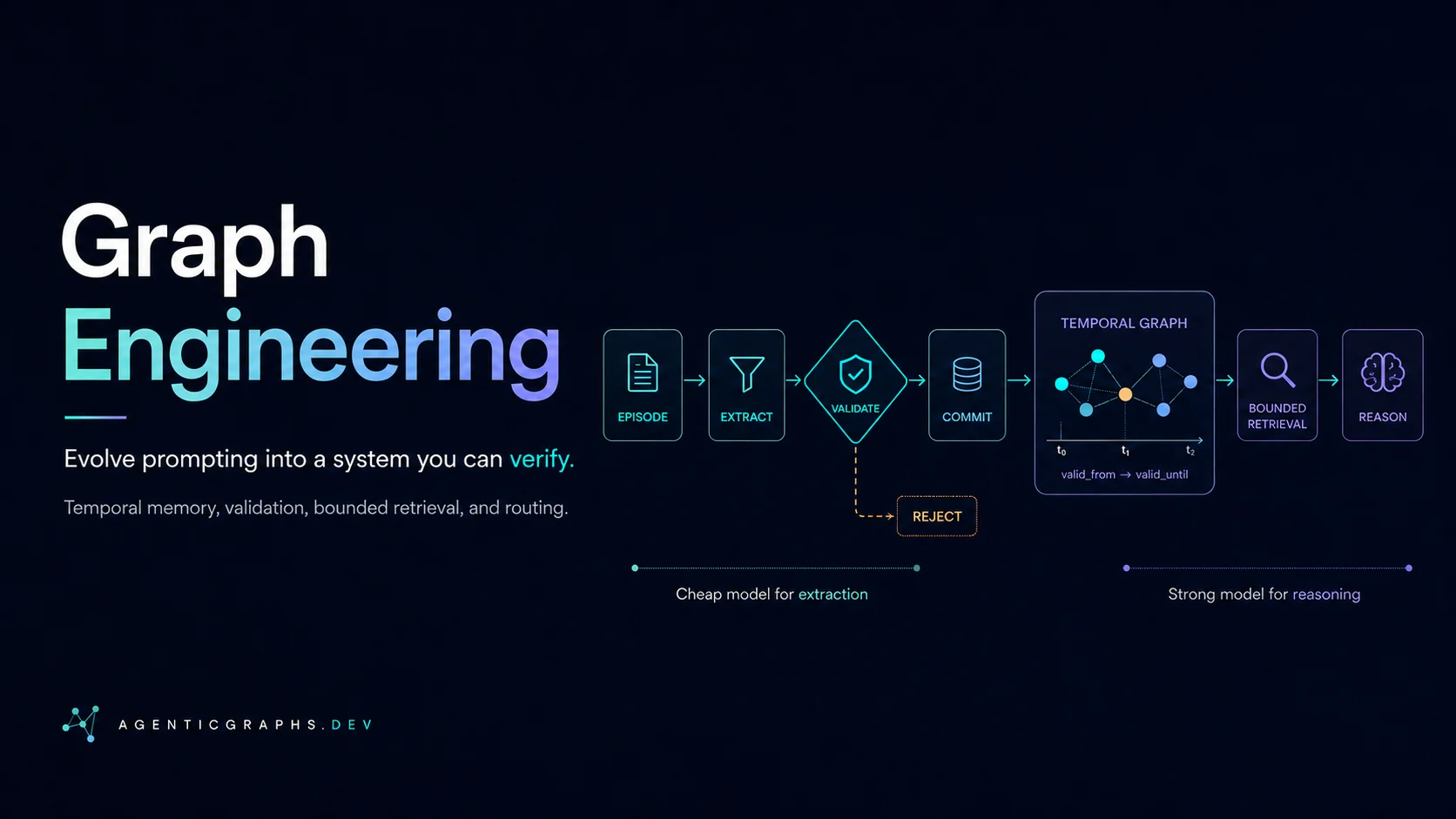
Graph Engineering
Evolve prompting into a system you can verify.
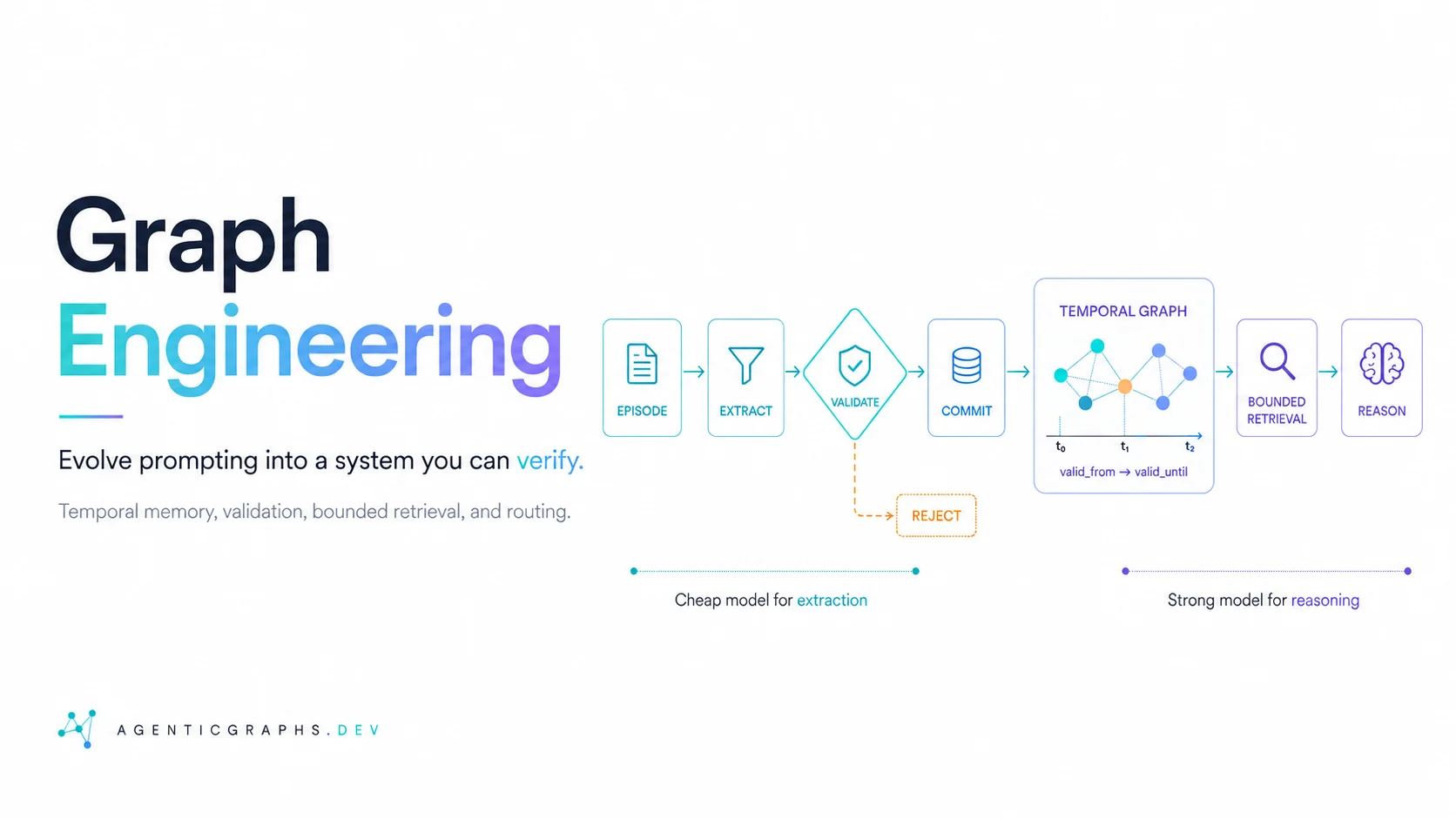
Build agent memory that survives the session: a temporal knowledge graph with a validation gate, cheap cached extraction, bounded retrieval that cites its evidence, and a routing policy that spends intelligence only where intelligence is needed.
Driven with Hermes Agent and GitHub Copilot CLI. Every command on this site was run before it was published.
What you'll build
Edges carry valid_from and valid_until, so it can answer where someone worked in 2024, not just today.
A closed relation vocabulary and endpoint consistency checks that reject incoherent edges before they enter memory.
A stable cached prefix and batched backfills, plus the honest measurement of when caching does and does not apply.
A bounded neighbourhood around your seeds, temporally filtered, citing the edges it used.
Your graph as persistent agent memory in Hermes and Copilot CLI. Verified to load.
A config file your system reads, not a slogan you repeat.
The whole idea, in one table
| Work | Volume | Judgment | Configuration |
|---|---|---|---|
| Extraction | Very high | Low, mechanical | Cheap model, cached prefix, batched |
| Traversal and reasoning | Low | High, multi-hop | Frontier model, small precise context |
Everything in this course is a consequence of that split.
Course outline
- 0. What this is, and what it isn't
- 1. Setup: Hermes and Copilot CLIHands-on
- 2. Graphs versus vectors, and why the answer is both
- 3. The temporal model: time is not metadataHands-on
- 4. Extraction, and what it actually costsHands-on
- 5. Agentic workflow graphs: prompts with contracts
- 6. The validation gate: stopping bad data before it compoundsHands-on
- 7. The routing policy: make the tradeoff executableHands-on
- 8. Wiring the graph into Hermes and Copilot CLIHands-on
- 9. Measure it, do not assume itHands-on
- 10. The production track: Neo4j and GraphitiHands-on
- 11. What you actually learned